
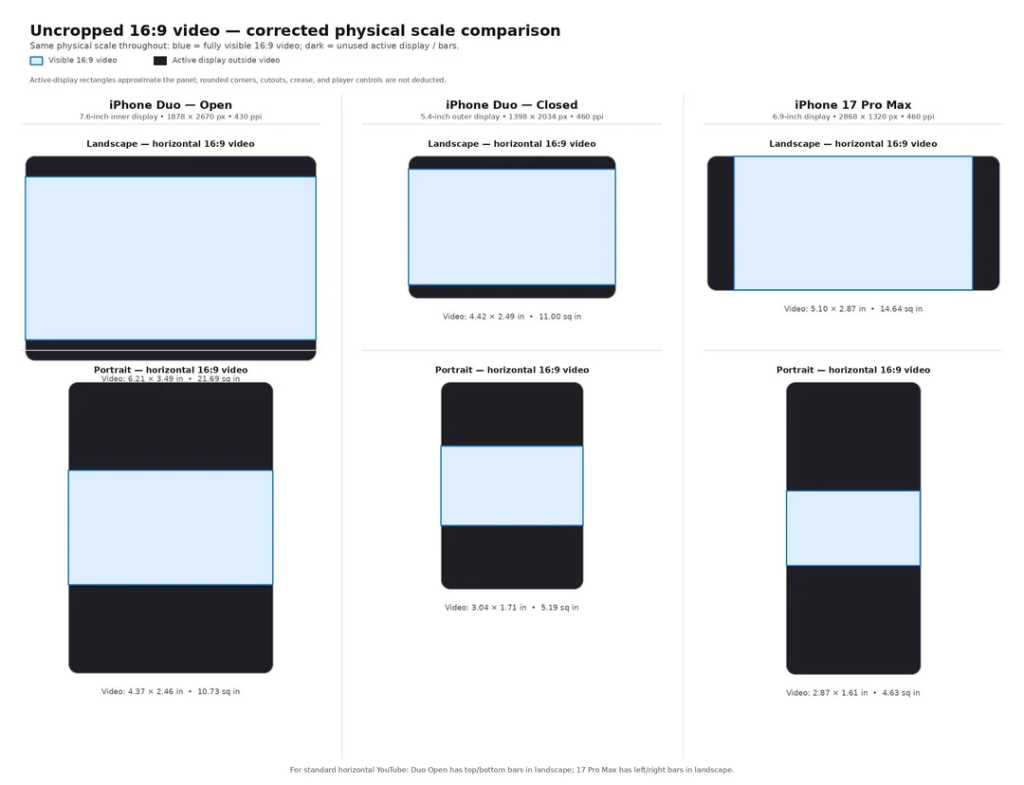
On paper, the specs sheet tells you the iPhone 17 Pro Max has a monolithic 6.9-inch diagonal display, while the incoming iPhone Duo sounds modest when folded shut at just 5.4 inches. But if you actually use your phone to watch YouTube, Netflix, or sports, that diagonal number is one of the most misleading marketing figures in consumer electronics.
When independent hardware enthusiasts mapped the physical square inches of uncropped 16:9 video across both devices, the results sent shockwaves through tech forums: Apple’s wider, squarer form factor on the iPhone Duo utterly crushes the iPhone 17 Pro Max in almost every real-world orientation.
- The Reality: Unfolded in landscape mode, the iPhone Duo delivers an astonishing 21.69 square inches of active 16:9 video—nearly 50% larger than the 14.64 square inches on the iPhone 17 Pro Max.
- The Portrait Shock: Even folded shut with a "tiny" 5.4-inch cover screen, the Duo renders 5.19 square inches of portrait video—beating the 6.9-inch Pro Max (4.63 sq in) because the Duo isn't an ultra-narrow tall aspect ratio slab.
- The Only Pro Max Win: The Pro Max beats the Duo in only a single configuration: watching 16:9 video in landscape while keeping the Duo folded shut (14.64 sq in vs. 11.00 sq in).
The “Diagonal Lie” That Phone Makers Rely On
For over a decade, smartphone manufacturers have pulled off a clever geometric trick. Every time a brand announces a larger screen—jumping from 6.1 inches to 6.7 inches, and now 6.9 inches on the 17 Pro Max—they stretch the display vertically.
Modern flagship slabs use tall aspect ratios like 19.5:9 or 20:9. Because Pythagorean geometry measures diagonals from corner to opposite corner, stretching a rectangle into a tall, skinny strip artificially inflates the diagonal inch rating without giving you equivalent usable surface area.
Standard video content, however, hasn’t followed phone makers down that path. The vast majority of YouTube videos, broadcast television, gaming streams, and sitcoms are produced in 16:9 widescreen.
When you play a 16:9 video on the 19.5:9 screen of an iPhone 17 Pro Max, massive black bars sandwich the footage on both sides. Nearly 18% of the active display you paid $1,299 for sits pitch-black and completely wasted unless you pinch-to-zoom and chop off the top and bottom of the frame.
The iPhone Duo breaks this cycle with a shorter, wider footprint:
- Inner display (unfolded): 7.6 inches, 1878 × 2670 pixels (430 ppi, roughly 1.42:1 aspect ratio).
- Outer cover display (folded): 5.4 inches, 1398 × 2034 pixels (460 ppi, roughly 1.45:1 aspect ratio).
Because both displays are significantly wider relative to their height, 16:9 video fits naturally with minimal letterboxing.
The Raw Numbers: Physical Video Surface Area Compared
Here are the precise, verified measurements of uncropped 16:9 video playback area across every physical orientation:
| Device & Orientation | Panel Diagonal & Resolution | Active 16:9 Video Area | Physical Dimensions (W × H) | Screen Fill Efficiency |
|---|---|---|---|---|
| iPhone Duo (Open Landscape) | 7.6” (1878 × 2670 px) | 21.69 sq in | 6.21” × 3.49” | 80.0% |
| iPhone Duo (Closed Landscape) | 5.4” (1398 × 2034 px) | 11.00 sq in | 4.42” × 2.49” | 81.8% |
| iPhone 17 Pro Max (Landscape) | 6.9” (2868 × 1320 px) | 14.64 sq in | 5.10” × 2.87” | 81.8% |
| iPhone Duo (Open Portrait) | 7.6” (1878 × 2670 px) | 10.73 sq in | 4.37” × 2.46” | 39.6% |
| iPhone Duo (Closed Portrait) | 5.4” (1398 × 2034 px) | 5.19 sq in | 3.04” × 1.71” | 38.7% |
| iPhone 17 Pro Max (Portrait) | 6.9” (2868 × 1320 px) | 4.63 sq in | 2.87” × 1.61” | 25.9% |
Look closely at the portrait numbers. That is where consumer intuition breaks down completely.
On the 6.9-inch iPhone 17 Pro Max, playing a video upright in portrait mode (how millions scroll YouTube feeds while glancing at comments) leaves you with just 4.63 square inches of visible image. Only 25.9% of that mammoth screen is actually displaying video.
Fold the iPhone Duo shut in your hand, leave it in compact portrait mode on its “small” 5.4-inch cover screen, and you get 5.19 square inches of visible video—a 12% larger picture than the giant Pro Max!
What About 4:3 Classics, Twitch, and Christopher Nolan’s IMAX?
The advantage becomes absurd once you move beyond standard 16:9 widescreen:
- Classic 4:3 Content: If you stream vintage anime, 90s television shows, or classic sitcoms, the Duo’s squarer aspect ratio eliminates pillarboxing entirely. On the unfolded 7.6-inch panel, 4:3 content fills virtually the entire display.
- IMAX 1.43:1 Formats: Christopher Nolan film fans and cinema purists have pointed out that the Duo’s native aspect ratio is shockingly close to authentic 1.43:1 70mm IMAX format.
- Split-Screen Multitasking: When open in landscape, you can pin a full-sized 16:9 video player at the top with 11+ square inches of picture, leaving the bottom half of the display entirely free for Safari, notes, or Reddit without shrinking the clip.
:::deal Product: Anker MagGo Qi2 Foldable 3-in-1 Wireless Charging Station Price: $79.99 Original: $109.99 Savings: Save $30.00 (27% OFF Early Bird) Code: DUOSTAND27 Link: https://www.amazon.com :::
The Hidden Trade-Offs: Weight, Thickness, and Missing Buttons
Before tossing your iPhone 17 Pro Max into a trade-in box, there are three severe real-world drawbacks every buyer needs to weigh:
1. It Is the Heaviest iPhone Ever Built
Early engineering leaks confirm the iPhone Duo weighs noticeably more than even the iPhone 14 Pro Max (240g) and the 18 Pro Max. Holding a device over 260 grams single-handed for an entire feature-length film or two-hour podcast will cause severe hand fatigue without a desk kickstand or MagSafe grip.
2. No Action Button and Modified Camera Bumps
Teardown blueprints indicate Apple omitted the dedicated capacitive Action Button and simplified the camera layout to shave critical millimeters off the folding chassis. If you rely on custom Shortcuts or telephoto periscope zoom lenses, the Pro Max remains Apple’s supreme imaging tool.
3. Stereo Speaker Placement
One subtle engineering triumph: Apple placed the Duo’s stereo speakers on opposing diagonal edges across the fold. This ensures true left-right stereo separation regardless of whether you rotate the device clockwise or counter-clockwise in landscape.
The 3-Step Field Guide: Which Device Fits Your Media Habit?
- Check Your Rotation Habit: Open your iPhone battery and screen-time settings. If 80%+ of your video time is spent in portrait mode browsing YouTube feeds, Reddit clips, and TikToks, the Duo’s wider cover screen gives you a superior experience without even opening the hinge.
- Measure Your Bag vs. Pocket Preference: If you carry your phone strictly in tight jeans pockets, the folded thickness and weight of the Duo will be immediately noticeable compared to the slimmer titanium slab of the Pro Max.
- Do the Tablet Math: If you currently carry both an iPhone and an 8.3-inch iPad Mini for travel or commuting, the unfolded Duo’s 21.69 square inches of video eliminates the need for a secondary tablet entirely.
Frequently Asked Questions
Does the iPhone Duo crease distort video playback across the fold?
Why does the 5.4-inch cover display show more portrait video than a 6.9-inch screen?
Can the unfolded iPhone Duo replace an iPad Mini 6 or 7?
Are you willing to carry the heaviest iPhone in Apple’s history for tablet-grade video playback, or is the classic Pro Max slab still king? Drop your take in the comments below!
🛡️ DAYLL Editorial Transparency
This post was researched and synthesized by the Dayll consumer editorial team. We test, verify, and cross-reference public policies and insider tips to bring you actionable advice without sponsor influence.


